Skip to content
Accessibility Statement

What Grips Wet Decks? 5 Sandal Features That Work

What Grips Wet Decks? 5 Sandal Features That Work

The science behind wet-surface traction in sandals, from razor-siping to Wet Grip Rubber, for confident footing on boats, docks, and rivers.

Key Takeaways

  • Siping is the single biggest lever on a wet deck: thin slits in the rubber open under body weight, force water sideways, and put more sole back in contact with the surface.
  • A non-marking compound is what lets a sandal hold a boat deck without leaving black streaks on the gelcoat.
  • What fails on a wet surface is a hard, flat outsole rather than a leather upper: neolite and hard-soled leather sit at the low end of wet friction.
  • Our Wet Grip Rubber outsole pairs a non-marking compound with an anatomical contoured footbed, and we build it for exactly these conditions: slick decks, wet rock, and dock boards.
Real traction on a wet surface comes down to soft, siped rubber that channels water away and holds contact with the ground, not to a stiffer material underfoot. Five features consistently separate a sandal that stays planted on a slick deck from one that slides.

1. Wet Grip Rubber Outsoles: The Foundation

Wet Grip Rubber Outsoles

Our proprietary Wet Grip Rubber is a non-marking outsole technology built to deliver enhanced traction on slick surfaces like boat decks, wet rocks, and docks. It's the foundation every other traction feature builds on, since no amount of tread pattern or footbed support helps if the base rubber compound can't hold the surface. This is the starting point for any sandal meant for time on the water.

Loading...

--
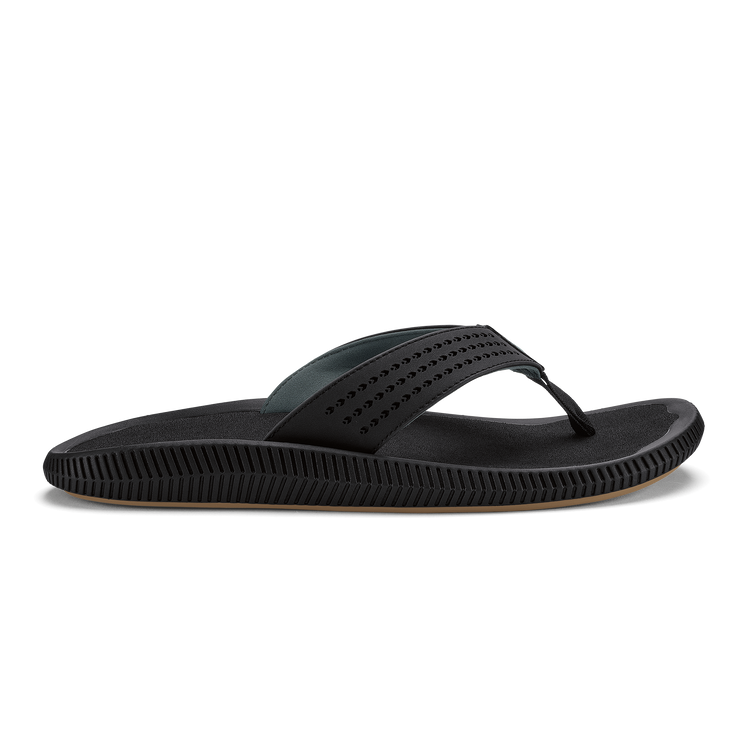
The Ulele (oo-LEH-leh) pairs a subtle brushed footbed with a Wet Grip Rubber outsole for more confident steps on wet surfaces, and its water-resistant, lightweight build is designed to float, making it a solid companion for water-bound adventures. It runs true to size and comes in wide widths, so order your usual size and size up only if you are between sizes. Rinse it with fresh water and air-dry it out of direct sun after saltwater days. Every pair is backed by a 1-year warranty and free 30-day exchanges.

2. Razor-Siped Tread Patterns

Razor-Siped Tread

Razor-siping cuts thin slits into the rubber that open under pressure to expel water and increase surface contact. Our Kīpī (kee-pee) sandal puts that to work with a siped and lugged Wet Grip Rubber outsole, and it is tested and approved by the Hawaiian Lifeguard Association. Multidirectional tread and deep grooves act like squeegees, channeling liquid away so the rubber stays in direct contact with the ground instead of hydroplaning across it on a wet dock or slick rock.

3. Non-Marking Rubber Soles for Boats

Non-Marking Soles

Non-marking rubber outsoles are essential for sailing and fishing because they hold traction without leaving scuff marks on a clean deck. By contrast, NIOSH slip-resistance testing puts hard sole materials such as neolite and leather at the low end of wet coefficient of friction on smooth surfaces, which is why we build our marine and fishing sandals on high-friction, non-marking rubber rather than treating it as a nice-to-have.

4. Quick-Dry, Water-Expelling Uppers

Water-Expelling Uppers

What sits on top of your foot matters as much as the outsole underneath. An open sandal sheds water on its own, which is a real advantage over a closed shoe on a wet deck. When you want closed-toe coverage instead, our ʻAhi (AH-hee) marine shoe uses a water-expelling mesh upper and strategically placed drainage windows to prevent that heavy, soggy feeling after a wave. Our leather styles are water-resistant, not waterproof, so they handle splashes and spray but shouldn't be treated as fully submersible unless a specific SKU is labeled waterproof.

5. Anatomical Contoured Footbed and Drop-In Heel

Footbed and Drop-In Heel

An anatomical contoured footbed provides high arch support for sustained all-day comfort during long days on the water. Paired with our proprietary Drop-In Heel, which we build into sandals as well as shoes, a single pair works as both a secure closed heel and an easy-wear slide, with no break-in period. On an unstable, wet surface that support is what keeps a full day on your feet from wearing you down.
What makes a sandal grip wet surfaces like boat decks or wet rocks?
Three things working together: a soft rubber compound, siping that opens under your weight to push water out of the way, and open tread that clears whatever is left. ASTM F2913 is the whole-shoe test the industry uses to put a number on it.
Are OluKai sandals waterproof?
Our synthetic water-ready sandals like the Ulele are built to get soaked, and the Ulele even floats. We make our leather styles water-resistant rather than waterproof: they shrug off spray and the odd wave, but they are not built to be soaked through. A few SKUs are explicitly waterproof and are labeled that way.
What is Wet Grip Rubber?
It is our proprietary non-marking outsole compound, and it is on most of what we build for the water, from the Ulele sandal to the Kīpī. Non-marking means it grips a deck without leaving black streaks behind.
Why do non-marking soles matter for boaters and anglers?
Because a dark rubber sole will streak a white gelcoat deck, and those marks are a chore to scrub off. A non-marking compound gives you the same footing without the cleanup, which is why most boat owners ask about it before anything else.
Is a leather sandal a good choice for wet, slick surfaces?
It depends on the outsole, not the upper. Leather that has been used as the sole gives up grip the moment it gets wet, so we put our water-ready styles on siped, non-marking Wet Grip Rubber instead. Our leather uppers are water-resistant rather than waterproof, so rinse and air-dry them after a day on the boat.